
Laser "Toxic Gas Capture": Guoke Hanhai Builds a Toxic Gas Protection Network for Jingmen Petrochemical
Centered on TDLAS technology, Guoke Hanhai has tailored a "laser toxic gas capture system" for Jingmen Petrochemical, making invisible toxic gases nowhere to hide. At petrochemical production sites, hydrogen sulfide and ammonia are like hidden "invisible killers" – the former can be fatal at concentrations of just a few parts per million, while the latter's strong irritancy can instantly burn the respiratory tract. In the refining unit areas of Sinopec Jingmen Branch, the leakage risk of these highly toxic gases has always been the top priority for safe production. With TDLAS technology as the core, Guoke Hanhai Laser Technology has customized a "laser toxic gas capture system" here, leaving invisible toxic gases with nowhere to escape.
01. Project Background: Why Install "Laser Alarms" for Toxic Gases?
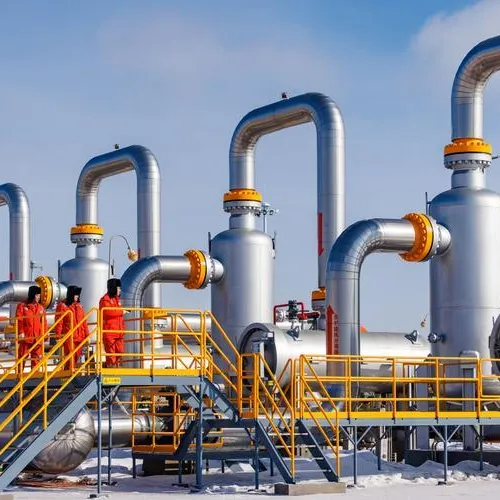
The desulfurization pump area of the delayed coking unit in the Second Refining Department of Jingmen Petrochemical is a high-risk area for hydrogen sulfide. This colorless and odorless gas has strong neurotoxicity, and short-term exposure to high concentrations can cause suffocation. Meanwhile, ammonia leakage is another major hazard in the 1#-4# machine cooling rooms of the paraffin molding unit in the Special Oil Department – behind its pungent odor lies a severe corrosion threat to the skin and mucous membranes.
In accordance with the national standard GB/T50493-2019, these areas must be equipped with high-precision monitoring equipment. However, traditional point-type detectors have limitations such as limited coverage and delayed response, making it difficult to address leakage risks in complex unit areas. During the full-plant shutdown maintenance in 2022, Jingmen Petrochemical resolved to upgrade its monitoring system, and Guoke Hanhai's fixed reflective laser gas telemetry instrument became the breakthrough choice – like "laser radar", it uses an invisible laser beam to scan a 100-meter range, capturing ppm-level gas leaks in milliseconds.
02. Technical Solution: How Three Laser Beams Weave a Protection Network?
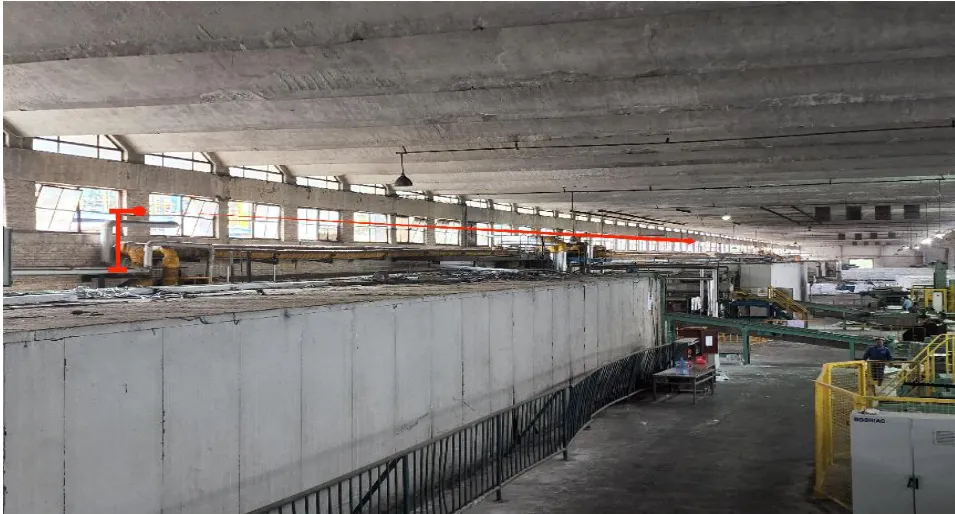
Targeting Jingmen Petrochemical's pain points, Guoke Hanhai deployed 3 sets of fixed reflective laser gas telemetry instruments, forming a "point-to-point" precise monitoring network:
In the solvent regeneration area and fractionation area of the residue hydrotreating unit, one laser device is set up to form a 100-meter-long monitoring channel. Installed at a height of 0.8 meters, the device sends laser beams back via a corner cube reflector installed at the same height on the opposite side, creating a "gas sensing line" spanning the unit area. When hydrogen sulfide leakage passes through the laser beam, specific wavelengths of the laser are absorbed, and the system immediately calculates the concentration and triggers an alarm.
In the desulfurization pump area of the delayed coking unit in the Second Refining Department, another device is installed at a height of 1 meter, covering a 100-meter channel above the pump area. With dense pipelines and frequent operations here, the laser beam is not affected by equipment obstruction, providing 24/7 monitoring of potential leakage points.
In the machine cooling rooms of the paraffin molding unit in the Special Oil Department, the third device is dedicated to ammonia monitoring. Installed 50 centimeters higher than the tallest pipeline, it ensures the laser beam can scan all potential leakage points of pipeline interfaces.
All optical fibers and cables of the equipment are laid through cable trays, with the parts outside the trays protected by galvanized steel pipes. Explosion-proof boxes are directly mounted on vertical poles – this "armor" enables the equipment to operate stably in the high-temperature, high-humidity, and dusty chemical environment.
03. Practical Acceptance: How Sensitive is the Laser "Nose"?
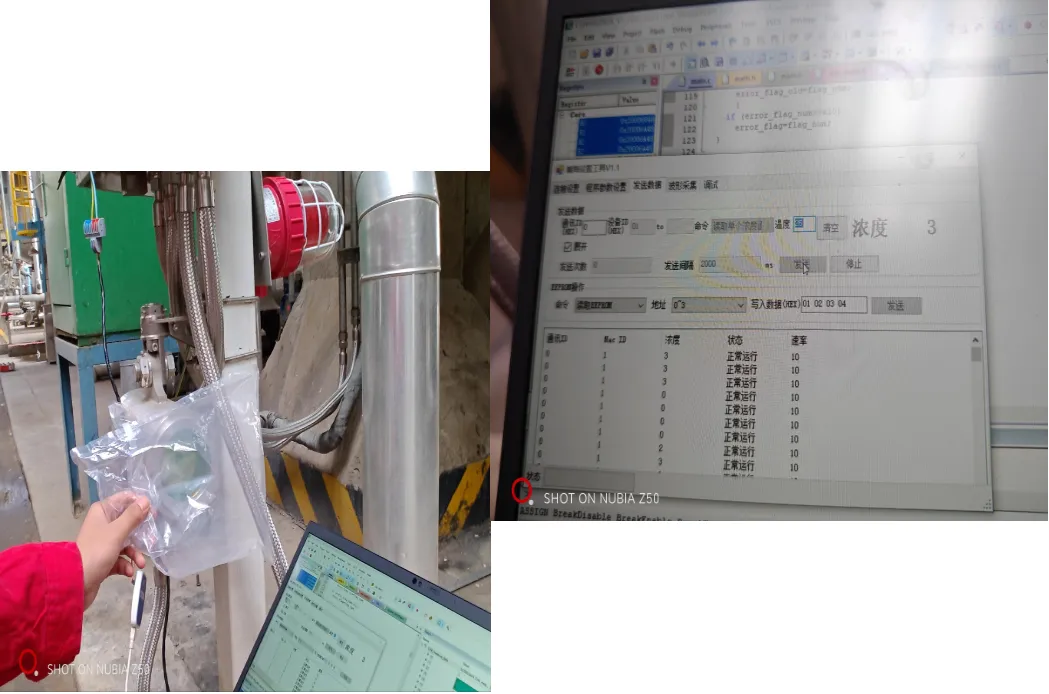
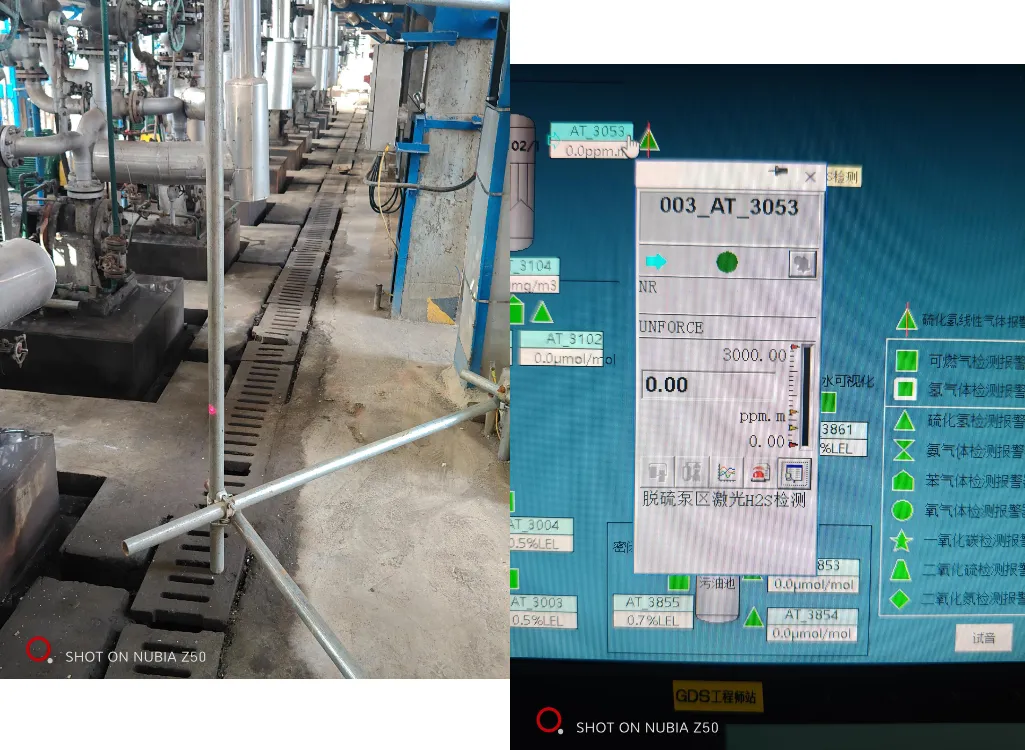
During project acceptance, engineers used 10-centimeter gas bags to simulate gas leakage. When tested in front of the lens of the hydrogenation area equipment, the system immediately displayed a hydrogen sulfide concentration of 2-3 ppm; when tested 100 meters away beside the corner cube reflector, the signal was also accurately captured. After adjustment via the 4-20mA signal in the central control room, the DCS system finally showed 0.75 ppm, meeting the sensitivity requirements completely.
In the commissioning of the coking area, the system maintained a small fluctuation range of -0.3~0.5 ppm without leakage; in the ammonia test of the paraffin area, the software displayed 4-5 ppm when the gas bag was close to the lens, and the reading in the central control room stabilized at 0.5 ppm after adjustment. All three sets of equipment passed acceptance at one time and were officially put into service.
04. Value Upgrade: From "Passive Detection" to "Active Prevention and Control"
This laser monitoring system has brought qualitative changes to Jingmen Petrochemical:
The monitoring range has expanded more than 3 times, no longer limited by single-point deployment.
The emergency response efficiency has increased by 70%, and the millisecond-level alarm speed has gained crucial time for disposal.
Personnel no longer need to conduct close-range inspections in high-risk areas, significantly reducing occupational health risks.
More importantly, it has promoted the transformation of the safety management model – from the previous passive response of "handling after leakage" to the active prevention and control of "real-time monitoring and early warning". Today, safety personnel at Jingmen Petrochemical can grasp the gas status of all high-risk areas in the central control room. Once the concentration exceeds the standard, an acousto-optic alarm will sound immediately, and the leakage location can be accurately positioned.
05. Postscript: Technology Makes Chemical Production Safer
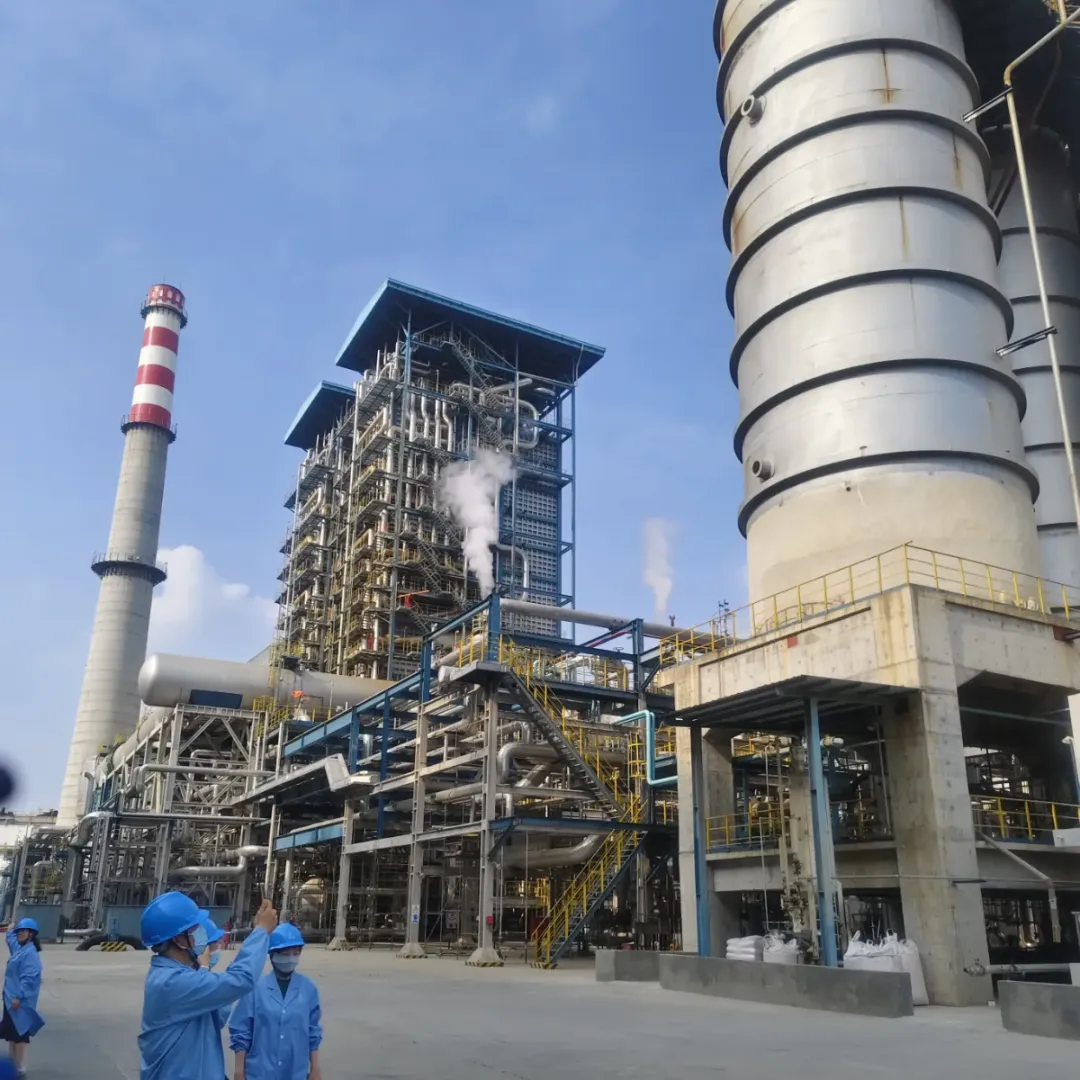
The monitoring of hydrogen sulfide and ammonia has long been a common challenge in the petrochemical industry. Guoke Hanhai has provided an answer with laser technology: the high sensitivity and selectivity of TDLAS technology leave toxic gases nowhere to hide; the fixed reflective design breaks through the limitations of traditional point-type monitoring.
This project has not only built a solid safety defense line for Jingmen Petrochemical but also become a model for toxic gas monitoring in the petrochemical industry. In the future, with the in-depth integration of the system and the production management platform, more intelligent risk prediction will be realized here – when there are slight fluctuations in gas concentration, the system can analyze trends and prompt inspections, making the safe production goal of "zero leakage" possible.
On the front line of chemical production, every progress in technology is the most powerful protection for life. Guoke Hanhai's laser "toxic gas capture" technology is making more industrial sites free from the threat of toxic gases.